


| 11th June 2025 | WEEKLY NOTES SPECIAL | FOR MEMBERS ONLY |

Comprehensive Spending Review 2025
Clearly, it was a challenging Spending Review for the Chancellor, given that the government is keen on sticking to its fiscal rule, but it was positive that the government announced £39 billion for social and affordable housing over the next ten years. This provides much-needed certainty and investment in housing over the long term, as well as a structural uplift to social and affordable house building. However, given that the vast majority of housing in the UK is private, affordability remains the most significant constraint to house building in the short-term, and the lack of a policy to enable demand for first-time buyers remains a great concern. There was also certainty of funding for transport and flood defences in particular over the Spending Review period to 2029/30, and we also eagerly anticipate government’s upcoming 10-year infrastructure strategy, which will be critical to give the whole supply chain the confidence to invest in the skills, capacity and innovative methods to deliver it.
Now that government has provided the certainty of funding over the Spending Review period, to 2029/30, what will be critical is to see delivery on the ground that matches its announcements.
Whilst there was positive focus on housing, infrastructure and resilience, there was a lack of much-needed policies to help UK manufacturing on energy prices, and it will be essential that the government’s upcoming Industrial Strategy, as competitiveness is vital for the future of the UK’s foundation sectors.
Economic and Fiscal Overview
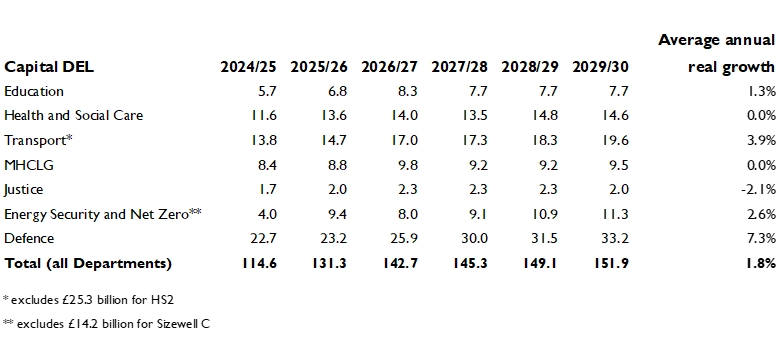
The government’s Spending Review sets departmental budgets for day-to-day spending until 2028/29, and until 2029/30 for capital investment. Across all departments, capital investment is set to increase at an annual average rate of 1.8% in real terms over the Spending Review period 2025/26 to 2029/30, an overall increase of one-third in nominal terms. A breakdown of capital expenditure limits by key departments (i.e. their budget) is below:
The funding allocations announced in the Spending Review that are relevant to businesses and industry are listed below. However, it is important to note that whilst some context has been added, given that some of these may be reannouncements of existing commitments or allocations of existing funding, the full interpretation and context of today’s announcements will take longer to analyse.
National and Regional Infrastructure
- Up to £27.8 billion capital to be invested through the National Wealth Fund (NWF), which will drive growth and create jobs across the UK. The NWF prioritises investment into the clean energy, digital and technologies, advanced manufacturing, and transport sectors. The NWF will consider investments in dual‑use technologies and investments to support supply chain resilience across its priority sectors
- £15.6 billion total has been allocated to 2031/32 for the elected mayors of England’s largest city regions via the Transport for City Regions (TCR) settlements, supporting them to invest in their local transport priorities, including zero emission buses, trams and local rail. This will more than double real terms city region transport spending per year by 2029/30, compared to 2024/25. This allocation matches what was set out in the second City Region Sustainable Transport Settlements (CRSTS2) in 2023 under the previous government. Over Phase 2 of the SR period (2026/27 to 2029/30), the total investment in England’s city regions is £9 billion.
- £25.3 billion is provided to progress delivery of HS2 from Birmingham Curzon Street to London Euston. This funding will support the full reset of the HS2 programme announced at the start of the year.
- £2.3 billion in the Local Transport Grant for local transport improvements including bus lanes, cycleways and congestion improvement measures in places outside of those areas receiving TCR settlements.
- £616 million to build and maintain walking and cycling infrastructure
- £2.2 billion of funding between 2026/27 and 2029/30 for Transport for London’s capital renewals programme. TFL’s capital renewals programme received £485 million from central government in 2025/26
- The government will provide £10.2 billion for rail enhancements (excluding HS2) over the period, including: allocating £3.5 billion in funding for the Transpennine Route Upgrade, allocating £2.5 billion to progress the delivery of East West Rail, £445 million for rail enhancements in Wales, including for the Burns Review stations, North Wales Level Crossing, Padeswood Sidings and Cardiff West Junction, £240 million to enhance Leeds station and undisclosed investments for the North of England and the Midlands Rail Hub West.
- £24 billion of capital funding between 2026/27 and 2029/30 to maintain and improve motorways and local roads across the country. Funding for RIS 3 was expected to be confirmed in the Spending Review but was not explicitly mentioned.
- £14.2 billion was confirmed for Sizewell C nuclear power station over the SR period, £2.5 billion to enable one of Europe’s first Small Modular Reactor programmes, with Rolls-Royce SMR selected as preferred bidder to partner with Great British Energy
- At least £7 billion in this Parliament is committed for the renewal of military accommodation, including over £1.5 billion new investment for rapid work to fix forces family housing.
- The government will publish its 10-Year Infrastructure Strategy later this month, which will set out a long-term plan for how infrastructure projects are planned and delivered. It aims to set out a new approach to infrastructure, providing certainty and stability to industry, reforming institutions and removing barriers to delivery.
- £80 million over the SR period for port investment to support floating offshore wind deployment in Port Talbot, subject to final due diligence.
- £4.2 billion over three years, from 2026‑27 to 2028‑29, to build and maintain flood defences, protecting communities across England from the dangers of flooding.
Skills and Investment
- HM Treasury has published the findings of its review into the Green Book, the government’s guidance on public investment appraisal, which is likely to favour investment in particular areas of need rather than using Benefit-Cost Ratios that skew investment to areas in which the economic return is greatest such as London and the South East.
- The government is also establishing a Growth Mission Fund to directly support local economic growth. This fund will invest £240 million of capital from 2026/27 to 2029/30 in projects that enable local job creation and the economic regeneration of local communities. Further detail on this fund and the criteria that will be applied for project selection will be set out later this Summer.
- £300 million Great British Energy support over the period for Offshore Wind supply chains – mobilising additional private investment, and securing manufacturing facilities for critical clean energy supply chains such as floating offshore platforms.
- The government has reaffirmed its commitment to rebuild over 500 schools through the School Rebuilding Programme, providing around £2.4 billion in each of the next four years (funding in 2025/26 was £1.4 billion). The government will also commit to expanding the programme beyond the current SR period as part of the forthcoming 10 Year Infrastructure Strategy, providing long-term certainty for the programme out to 2034/35.
- Annual maintenance investment for schools will increase in line with inflation, rising to £2.3 billion in 2029/30 to improve the condition of the school estate, an increase of over £400 million per year by 2029/30, compared with 2024/25. For 2025/26, funding to improve the condition of the estate was £2.1 billion.
- DHSC’s annual capital budgets will increase £2.3 billion in real terms (a £4 billion nominal increase) from 2023/24 to 2029/30 to invest in the NHS, including in new technology, hospitals and primary care. This includes the 25 new hospitals/hospital buildings via the New Hospitals Programme
- The government is providing £7 billion between 2024/25 and 2029/30 to deliver the commitment to build 14,000 new prison places by 2031.
- The government confirmed £625 million between 2025/26 and 2028/29 to train up to 60,000 skilled construction workers, as announced at Spring Statement 2025
- £13.9 billion capital funding has been allocated to the Nuclear Decommissioning Authority (NDA).
Housing
- £39 billion was confirmed for a new 10-year Affordable Homes Programme running from 2026/27 to 2035/36. Spending will reach £4 billion per year in 2029/30 and rise in line with inflation subsequently
- Confirmation of a 10-year social housing rent settlement from 2026 at Consumer Price Index + 1%, alongside a consultation to follow shortly on how to implement social rent convergence (whereby similar rents are charged for similar homes across the country)
- Providing £2.5 billion of low-interest loans over the SR for social housing providers to further boost their capacity to invest in new development, as well as £4.8 billion in financial transactions (FTs) from 2026/27 to 2029/30 to attract additional private investment
- £1 billion of new investment between 2026/27 and 2029/30 to accelerate the remediation of social housing, by giving social housing providers the same access to government funding schemes as private building owners
- Investing in infrastructure and land remediation to deliver new housing schemes in partnership with the private sector – no further detail was provided
- The government will launch a permanent, UK-wide Mortgage Guarantee Scheme in July to ensure the consistent availability of mortgages for buyers with small deposits. The current scheme covers new 95% mortgages until 30 June 2025.
Decarbonisation and Net Zero
- Allocation of £9.4 billion to Carbon Capture, Usage and Storage (CCUS) over the SR period. This will maximise deployment to fill the storage capacity of the East Coast Cluster and HyNet Cluster. The government is announcing its support for the Acorn and Viking clusters and providing the development funding to advance their delivery. A final investment decision will be taken later this Parliament, subject to project readiness and affordability.
- The government is funding the Warm Homes Plan with a total of £13.2 billion over the SR period. This investment will be allocated across schemes that support the rollout of heat pumps, alongside energy efficiency measures and other low-carbon technologies, such as solar and batteries. The government will work with the UK’s expert public finance institutions, including the NWF (National Wealth Fund), to support the delivery of the Warm Homes Plan. Further details will be confirmed by October.
- £400 million to support the rollout of electric vehicle charging infrastructure and £1.4 billion to support continued uptake of electric vehicles, including vans and heavy goods vehicles (HGVs).

Copyright © 2025 CPA
All rights reserved.
Our mailing address is:
The Building Centre, 26 Store Street, London, WCIE 7BT
unsubscribe from this list | update subscription preferences